
Video editing has always required a mix of technical skill, patience, and a real feel for visual storytelling. Editors spend a lot of time going through raw footage, picking out the clips worth keeping, trimming what doesn’t belong, arranging scenes, adding captions, fixing audio, and preparing different versions for publication. AI is starting to change that process by letting creators describe certain editing tasks in plain language and get real help with the repetitive production work.
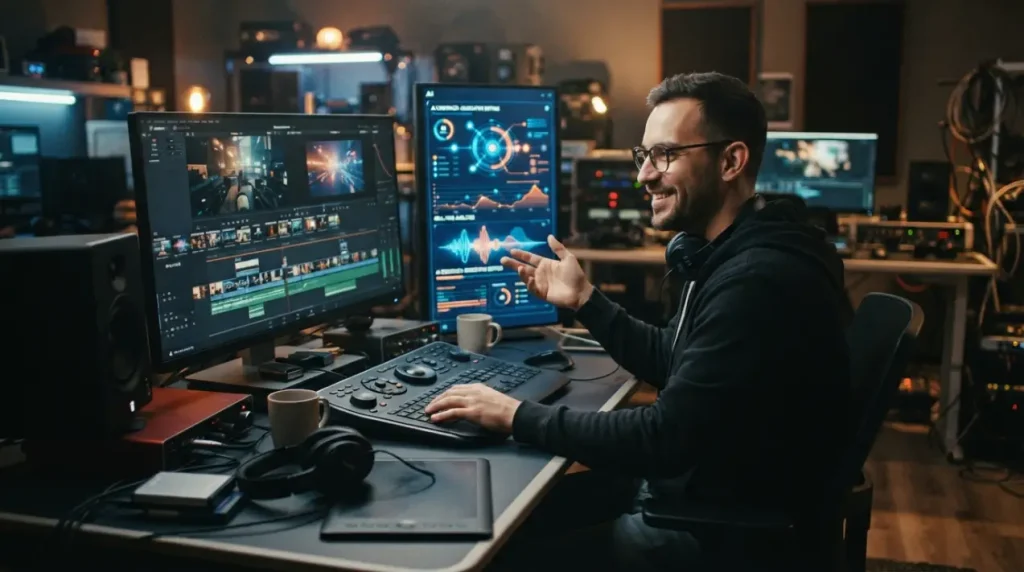
Rather than replacing traditional editing, AI-assisted tools are increasingly being used to build a starting point — something editors can actually review and shape into the finished product.
From Manual Editing to Just Describing What You Want
One of the more noticeable shifts in modern video production is being able to give editing instructions in ordinary language. Instead of manually performing every basic operation, a creator can describe the structure they want, how long the video should run, the pacing, or which moments matter most.
An editor working with an interview, for instance, might specify that the final video should focus on a handful of key statements, cut the long pauses, and keep a particular order. An AI-assisted workflow can then help identify the relevant parts of the footage and organize them into an initial draft to work from.
This changes what the editing timeline actually is for. It’s still central to the process, but it becomes the place where an AI-generated first draft gets inspected and improved, rather than where every single decision has to start from a completely blank slate.
How AI Helps Organize a Pile of Raw Footage
Large collections of video files are genuinely hard to manage. A creator might be sitting on hours of recordings, with useful moments buried somewhere in a lot of footage that doesn’t matter. Reviewing all of it manually eats a huge chunk of production time before any real editing even begins.
A conversational AI image creator workflow can help with exactly this early stage — using instructions to identify useful moments, cut what’s unnecessary, and organize selected clips into an editable rough cut. CapCut’s documented CapCut × Codex workflow, for example, describes exactly this — taking uploaded footage and natural-language instructions and turning them into an editable first cut.
The important thing to keep in mind is that an initial AI-generated arrangement isn’t necessarily the finished video. Human review still matters for checking context, continuity, pacing, and accuracy.
Why the Rough Cut Stage Matters So Much
A rough cut is one of the most valuable stages in video production, because it establishes the basic structure before any of the detailed visual polishing starts. It’s where an editor can actually tell whether the story holds together and whether the material selected actually supports the message.
AI can speed this stage up considerably by organizing clips according to instructions. Once that rough cut exists, an editor can reorder things, tighten up scenes, cut more material, or bring back footage the automated process happened to skip over.
This kind of workflow tends to help most with interviews, tutorials, demos, educational videos, and social content — anywhere the same basic editing decisions get repeated across a lot of similar projects.
Captions and Making Video Genuinely Accessible
Captions have become a genuinely important part of online video, mostly because so many people watch with the sound off. They also make content a lot more accessible to viewers who are hard of hearing or who speak a different language.
AI-assisted workflows can help draft caption text and generate language variations quickly. Automatically generated captions still need a real review, though — names, technical terms, accents, background noise, and overlapping speakers all tend to trip up automated transcription.
It’s worth treating automated captions as a draft, not as something guaranteed to be word-perfect. Timing, punctuation, spelling, and placement all deserve a check before anything goes out publicly.
Adapting One Video Into Several Formats
A single piece of footage often needs to become several different versions. A long horizontal video might need to shrink into shorter vertical clips for mobile, while a different version might need its own captions or a rewritten intro entirely.
AI-assisted editing can cut down a lot of the repetitive prep that goes into building out these versions. Instructions can define target lengths, preferred sections, aspect ratios, or other requirements, and the editor reviews each variation once it’s put together.
This tends to help teams that produce content on a regular basis the most. Instead of treating every new version as its own separate project from scratch, creators can build a repeatable workflow and let AI handle a chunk of the setup work each time.
Human Judgment Hasn’t Gone Anywhere
Automation doesn’t remove the need for real editorial judgment. An AI system can flag technically relevant footage without ever understanding every subtle piece of what the video’s actually trying to say. A facial expression, a pause, a reaction shot, or some small background detail can carry real weight that’s genuinely hard to capture in a simple instruction.
Human editors are still the ones responsible for checking factual accuracy, copyright, privacy concerns, anything inappropriate, and the overall quality of the finished piece.
The most practical way to approach all this is really as a collaboration. AI handles parts of the prep work. People make the final creative and editorial calls.
A More Flexible Future for Video Production
AI-assisted editing is part of a bigger shift toward more conversational creative software in general. Instead of forcing users to learn every technical function before they can make anything, these systems let creators describe what they’re going for and get back an editable starting point instead of a blank screen.
The technology is most useful when it cuts down repetitive work without getting in the way of manual control. A genuinely good workflow lets creators inspect the source material, understand exactly what’s changed, and adjust the result whenever they need to.
As these systems keep evolving, video editing is likely to end up as a mix of natural-language instructions, automated organization, traditional timelines, and real human creativity working together. The goal was never to fully automate video production — it’s to make the trip from raw footage to a structured, editable draft faster, while keeping creative control exactly where it belongs.